

Aluminum alloy die-casting can produce large parts and can stably produce products such as box shells that require structural strength and dimensional accuracy, suitable for industrial, new energy and other fields.
Aluminum alloy material and process are suitable for the production of large parts. Aluminum alloy has strong rigidity (tensile strength 250-400MPa) and good corrosion resistance. When making large box shells, it can withstand external impacts (such as collisions during industrial equipment handling) and the weight of internal components (such as battery modules and circuit boards), and is not easily deformed. Aluminum alloy die-casting can be achieved through a large die-casting machine (locking force 1600T-6000T) to achieve one-time molding, avoiding the use of splicing technology for large box shells (reducing welding seams and improving sealing), such as new energy vehicle battery box shells (length 2-3m, width 1-1.5m). After one-time die-casting molding, the waterproof level can reach IP67, meeting outdoor use needs.
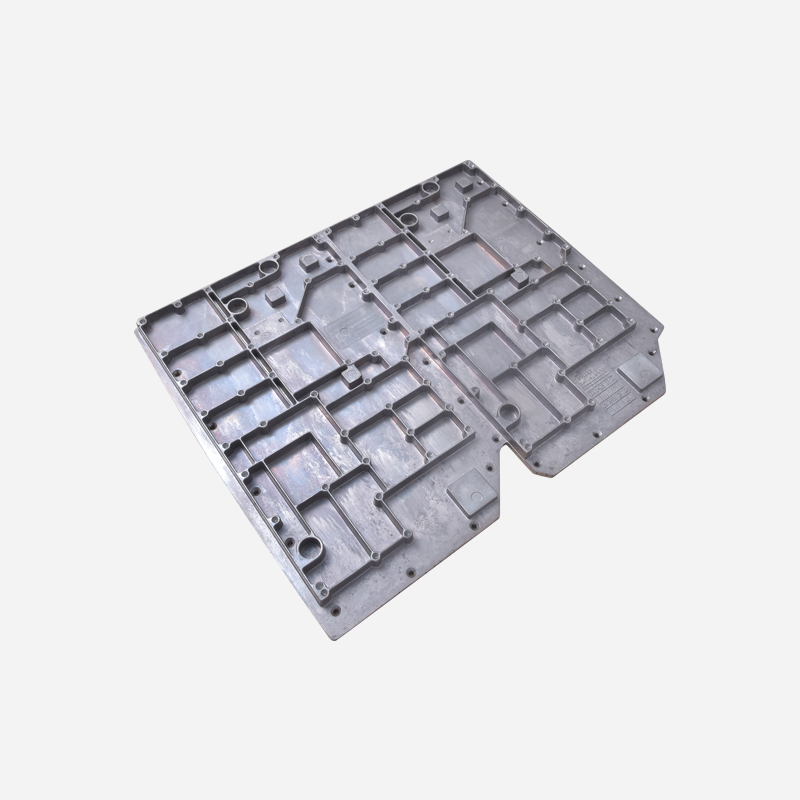
The size and performance parameters of the large box shell are clear. Common dimensions for aluminum alloy die-casting large box casings in the industrial field are: length 1-3m, width 0.8-2m, thickness 3-10mm, such as industrial control cabinet casings (length 1.5m, width 1m, thickness 5mm) and photovoltaic inverter casings (length 2m, width 1.2m, thickness 6mm). This type of casing requires reserved installation holes (aperture tolerance ± 0.1mm) and heat dissipation holes (size tolerance ± 0.2mm). The aluminum alloy die-casting accuracy can reach ± 0.05mm/m, which can meet the assembly requirements. The shell of the new energy vehicle battery case also needs to have anti extrusion performance (withstand extrusion force of ≥ 100kN without breaking). Aluminum alloy can improve its anti extrusion ability by adding silicon and magnesium elements (such as ADC12 aluminum alloy), which meets industry standards.
Process control ensures the quality of large box casings. Optimizing mold design is required for the production of large aluminum alloy die-casting box shells, using multi gate feeding (such as 3-5 gates) to ensure that the metal liquid evenly fills the large cavity (avoiding local material shortage); The mold needs to be equipped with an effective cooling system (such as a cooling water channel spacing of 50-80mm), controlling the molding temperature (mold temperature of 200-250 ℃, metal liquid temperature of 650-680 ℃), and reducing deformation of large parts caused by uneven cooling (deformation amount controlled within ≤ 2mm/m). After molding, X-ray inspection is required to check for internal bubbles (bubble diameter ≤ 0.5mm is qualified), in order to avoid cracking of the box shell caused by bubbles under stress.
Surface treatment is suitable for different usage environments. Large aluminum alloy die-casting enclosures for outdoor use, such as communication base station enclosures, require electrophoretic coating (paint film thickness of 20-30 μ m) or powder coating (coating thickness of 50-80 μ m). Salt spray testing can pass for 100-200 hours to prevent corrosion caused by rainwater and moisture. The casing of industrial workshops, such as machine tool distribution boxes, can be treated with anodizing to improve surface hardness (Hv ≥ 150) and prevent scratches caused by daily friction.
Clear adaptation scenarios and precautions. Aluminum alloy die-casting large box shells are suitable for mass production (minimum order quantity is usually 50-100 pieces), with a delivery cycle of 15-25 days (including mold debugging time). Due to the large volume of large items, customized packaging (such as wooden frames for fixation) is required during transportation to avoid collision and deformation during handling. When purchasing, a 3D drawing of the box shell (indicating dimensional tolerances, force points, and installation requirements) is required. The manufacturer will select the appropriate aluminum alloy material (such as ADC12, A380) and die-casting machine model according to the requirements to ensure that the product meets the standards.