

The parting surface is the "first threshold" of die-casting molds, and whether the demolding is smooth or not depends entirely on it
The parting surface, commonly known as the "opening and closing surface" of a die-casting mold, is tightly adhered when the mold is closed, and the molten metal is formed inside the mold; When the mold is opened, separate it along the parting surface and take out the formed product. Seemingly just a simple contact surface, it is the first key threshold in the design of die-casting molds. If the design is not done well, there will be continuous troubles in the future.
Many beginners in designing parting surfaces only pursue "being able to fit and demold", but overlook two core issues: the position of the parting surface and the flatness of the parting surface. If the position of the parting surface is not selected correctly, the product is prone to sticking to the mold, scratching, and even burrs and flying edges during demolding. Additional rework and trimming will be required in the future; Uneven parting surface can cause material leakage during mold closing, which not only wastes raw materials but also damages the mold.
Yurun designs parting surfaces based on two core principles: first, try to choose the maximum contour of the product as much as possible, so that the force is evenly distributed during demolding, making it less likely to stick to the mold, scratch the product, and reduce burrs; Secondly, the parting surface should be flat and smooth, with a tight fit to avoid mold leakage. At the same time, the convenience of subsequent trimming should be considered to minimize trimming processes and reduce production costs.
In addition, the design of the parting surface also needs to be coordinated with the subsequent pouring system and overflow groove. For example, the position of the parting surface should be convenient for the smooth filling of the metal liquid, and at the same time, the overflow groove should be able to accurately collect impurities and gases, without neglecting one aspect. This is the first step in collaborative optimization.
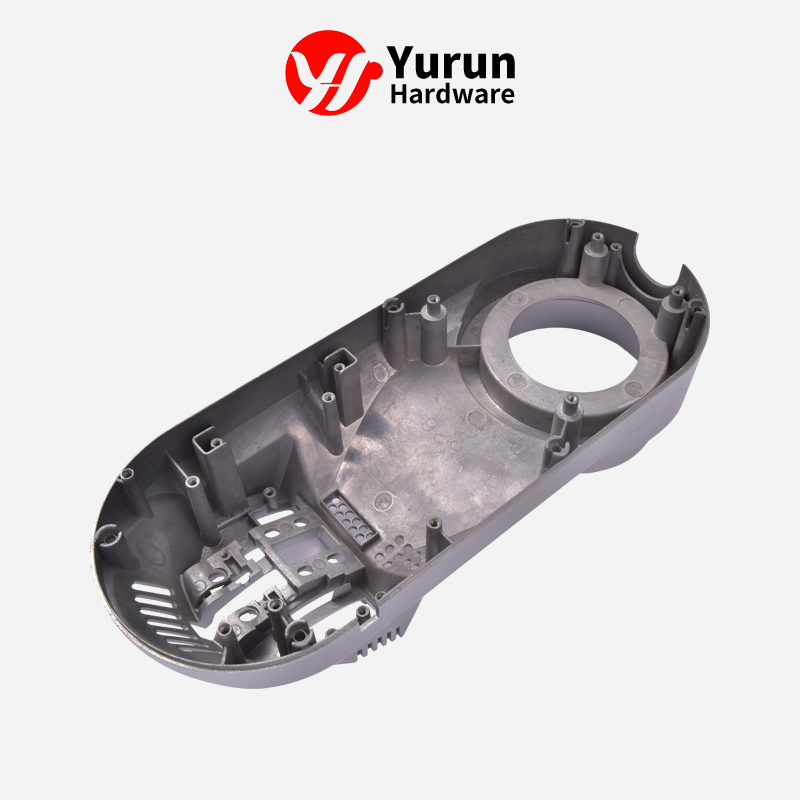
The pouring system is the "channel" of molten metal, and whether it is filled smoothly or evenly is the key
The pouring system is the "channel" in the die-casting mold that allows the molten metal to enter the mold cavity from the injection chamber, which is equivalent to paving a "dedicated route" for the molten metal. The design of this route directly determines the speed and uniformity of metal liquid filling, which in turn affects the quality of product molding - filling too quickly can produce pores and splashes; If the filling is too slow, the metal liquid will cool down in advance, resulting in material shortage and shrinkage problems.
Many people design pouring systems and blindly increase the size of the sprue, thinking that this way the metal liquid can be filled faster, but this is not the case. The gate size is too large, and the impact force of the metal liquid is too strong, which will impact the mold cavity, shorten the mold life, and also produce pores; The gate size is too small, the filling speed is slow, and it is easy to have material shortage and cold insulation.
Yurun designs a pouring system that accurately calculates the gate size, runner length, and angle based on the size, shape, and material of the product. The core is "smooth, uniform, and stable". For example, for small thin-walled products, choose a finer gate, control the filling speed, and avoid splashing; For large thick walled products, the gate should be appropriately increased to ensure rapid filling of the metal liquid, while optimizing the shape of the flow channel to reduce resistance during the flow of the metal liquid and avoid uneven filling.
More importantly, the pouring system should cooperate with the parting surface and overflow groove: the position of the sprue should be aligned with the core area of the mold cavity, and at the same time, the metal liquid should be able to smoothly push gas and impurities towards the overflow groove during the flow process, avoiding gas being trapped in the mold cavity and causing porosity defects.